
Fair private-party value
A low, mid and high value for that year, trim and mileage, with the asking price placed on the range.
Used car deal checker
Paste a listing or snap a few photos. AutoGauge estimates the car’s fair private-party value, scores the deal from 0 to 10, and shows what to inspect before you buy.


3-day free trial · iPhone, Android and Chrome
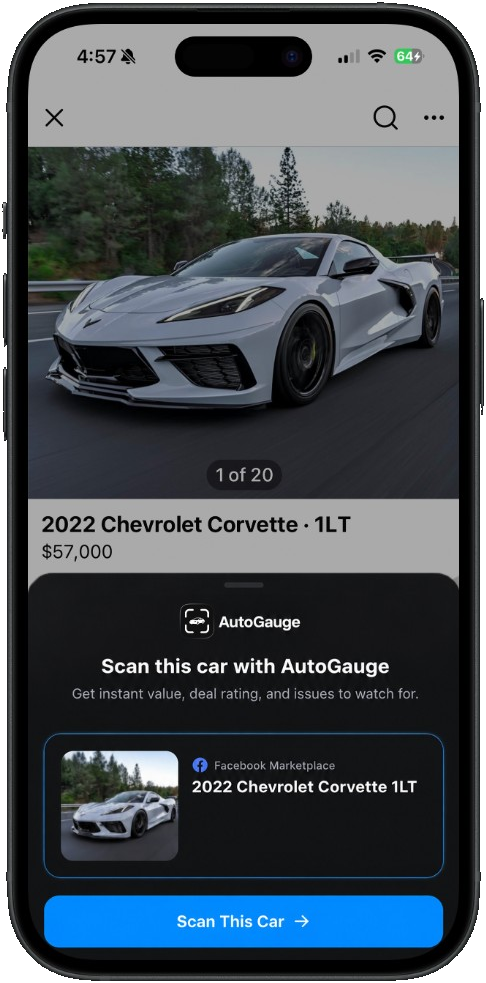

Everything you need to decide, in one report.
A low, mid and high value for that year, trim and mileage, with the asking price placed on the range.
A 0–10 score so you can tell a great deal from an overpriced one at a glance.
Common issues for that model and what fixing them usually costs, so a cheap car doesn’t turn expensive.
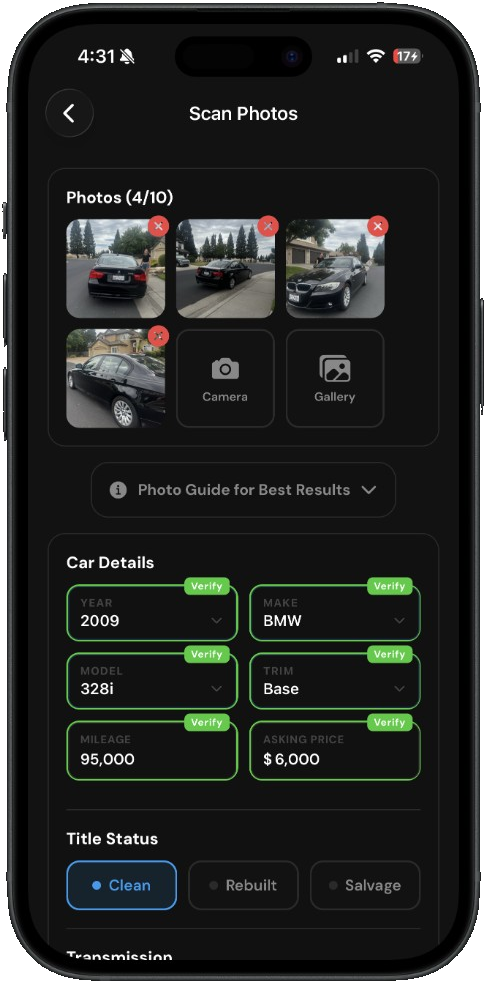
No link? Take up to 10 photos. AutoGauge reads the car and flags dents, rust, worn tires and interior wear.

Start with the car’s private-party value for its exact year, trim and mileage, not the dealer retail price. Then look at the model’s known weak spots: a low price can hide a repair that costs more than the discount.
Check open recalls and the title status, and plan an in-person inspection. AutoGauge puts the value, deal score, common problems, repair costs and recalls in one place, so you know which cars are worth seeing.
It reads the year, make, model, trim, mileage and condition from the listing or your photos, then estimates a private-party value range from current market data for similar cars.
8–10 is Excellent, 6–7 Good, 5 Fair, 2–4 Overpriced and 0–1 Avoid. The score compares the asking price with the car’s fair value.
Yes. Use photos in the app: screenshots or pictures of the car work, and you can confirm the year, miles and price before scanning.
AutoGauge is free to download, and the Unlimited plan starts with a 3-day free trial. You can also buy a scan pack instead of subscribing. The Chrome extension gives new users one free scan.
No. AutoGauge tells you what the car is worth and what to look at. Still inspect the car in person or with a mechanic before you buy.
AutoGauge is a research tool, not a replacement for a pre-purchase inspection. AutoGauge is not affiliated with Facebook or Meta.