
Names every light
Each warning light in the photo is identified and added to the report.
Dashboard warning lights
Red usually means stop soon, amber means get it checked, and green or blue just means something is on. Below are the common lights and what to do. Looking at a used car? Photograph the dash and AutoGauge names each light for that car.


3-day free trial · iPhone and Android
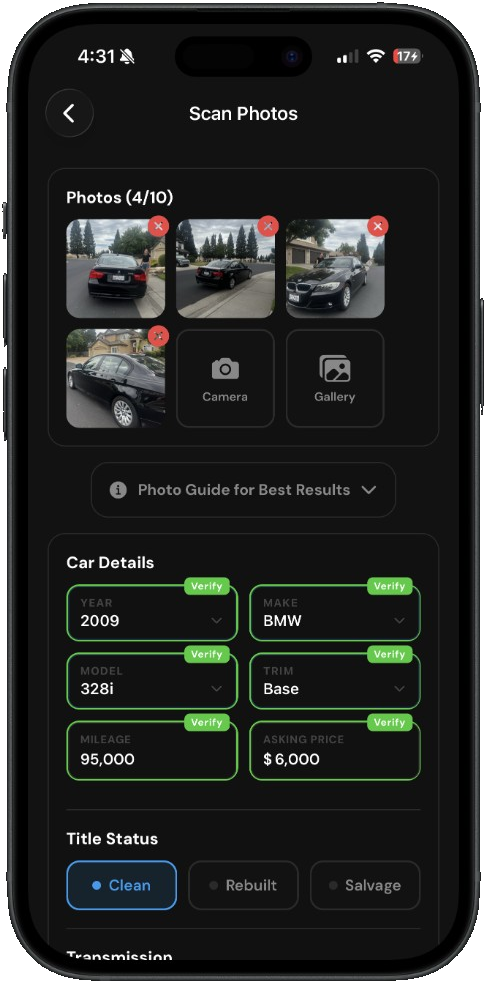

Add a photo of the gauge cluster to a photo scan.
Each warning light in the photo is identified and added to the report.
Each light is rated Critical, Serious, Caution or Info.
What the light usually points to on that make and model.
A recommended action, and the light is factored into the car’s known issues.
Exact symbols vary by make. Your owner’s manual has the full list for your car.
| Light | Usually means |
|---|---|
| Oil pressure | Low oil pressure. Stop when safe and turn the engine off; driving on can destroy the engine. |
| Engine temperature | The engine is overheating. Pull over and let it cool; don’t open a hot radiator cap. |
| Brake system | Parking brake on, low brake fluid or a brake fault. If the parking brake is off, get it checked before driving. |
| Check engine (flashing) | An active misfire that can damage the catalytic converter. Reduce speed and get it checked right away. |
| Battery / charging | The charging system isn’t keeping up, often the alternator or belt. The car may soon stall. |
| Airbag (SRS) | A fault in the airbag system. Airbags may not deploy in a crash. |
| Power steering | A power steering fault. Steering may get heavy. |
| Check engine (steady) | The engine computer stored a fault, from a loose gas cap to a failing sensor. Read the code soon. |
| ABS | Anti-lock brakes are off. Normal brakes still work, but not the anti-lock feature. |
| Tire pressure (TPMS) | One or more tires are low, or a sensor has failed. |
| Traction / stability control | Flashing means it’s working on a slippery road. Steady means it’s off or has a fault. |
| Low fuel | The tank is nearly empty. |
When you turn the key to “on” before starting, most warning lights should light up for a second as a bulb check, then go out. A light that never comes on at all can mean the bulb was pulled to hide a problem.
Ask to start the car cold, watch the dash during the bulb check, and photograph the cluster with the engine running. Add that photo to an AutoGauge scan and any light that’s on is named and rated in the report.

Red usually means a serious problem: stop soon or get help. Amber or yellow means something needs checking soon. Green and blue lights show a feature is on, like headlights or cruise control.
If it’s steady and the car drives normally, usually for a short time, but get the code read soon. If it’s flashing, reduce speed and get it checked right away to avoid catalytic converter damage.
Not without knowing why. Ask the seller to read the code or have a mechanic check it. Some causes are cheap, others cost thousands, and the light can be the most important thing to price in.
Yes. Add a photo of the gauge cluster to a photo scan. AutoGauge names each warning light, rates how serious it is for that car, and recommends what to do.
AutoGauge is a research tool, not a replacement for a pre-purchase inspection. AutoGauge is not affiliated with Facebook or Meta.